
Lizzie Wenger and the Places That Shape Us
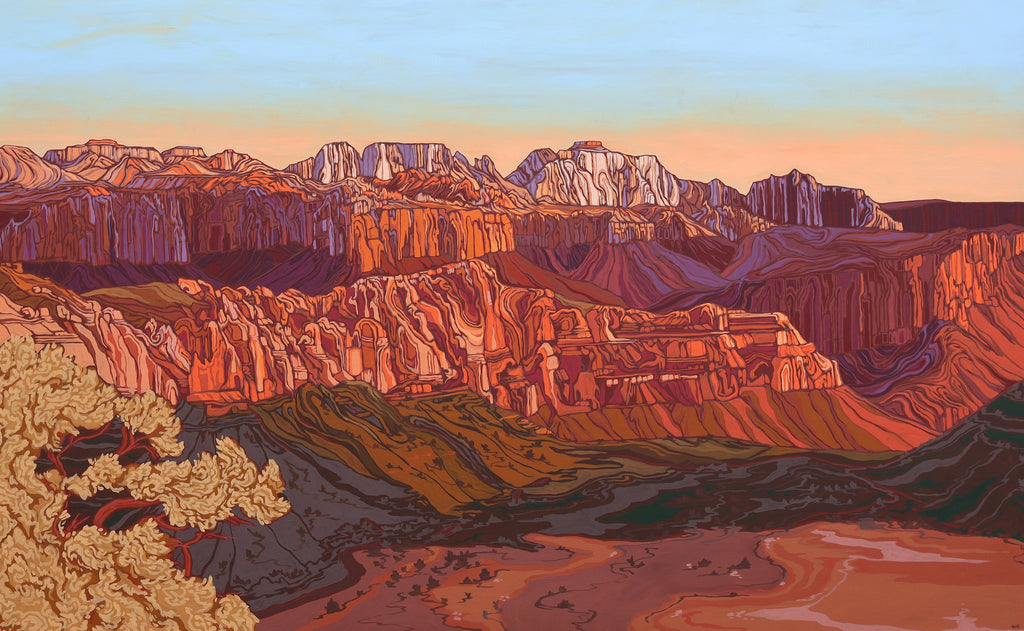
Moab has a way of shaping people through it's red rock walls, slow river bends, and the quiet lessons of time spent outside. For painter and muralist Lizzie Wenger, this desert landscape is more than inspiration; it’s home, teacher, and creative compass. Rooted in childhood memories and sustained through adulthood as a place of reset, Moab continues to inform Lizzie’s bold, psychedelic-cubist interpretations of the West. In this conversation, Lizzie shares her creative journey from college detours to full-time artistry, the role of fear and vulnerability in growth, and the power of art to connect people to place.
Lizzie, I'd love for you to introduce yourself and tell us why Moab is such a special place for you?
 My name is Lizzie Wenger, my work studies western landscapes in acrylic on canvas and through large scale murals! Growing up in Utah, Moab holds many of my childhood memories and first experiences in the desert wilderness. Exploring Moab and the surrounding areas shaped my identity as both an artist and outdoors-woman. In my adulthood, I frequent Moab as a creative "reset", spending as much time as I can on the river, exploring canyons, and climbing!
I am so curious if art felt important to you early on in your life. How would you say art shaped your life?
Art has been integral to my life, most of my early memories are attached to painting or drawing. Painting has served as a sort of wayfinder, when life got confusing or hard I always had something to stabilize me: a creative outlet to understand and process the world, or just an escape. I don't necessarily have a standout aha-moment, creating feels like it's woven into me and has been / will always be a priority.
So how did this all start for you? Has your creative adventure been an easy one? What led you to do art full time?

My creative adventure has most definitely been an adventure. I did not have a clear picture of how painting would look in my life, in fact, I never viewed it as a viable career option and took the standard college track. I continued to practice art on the side, but painting became less of a priority. I was in my sophomore year of college and working at a restaurant in 2020, when COVID led me to the decision to "take a semester off" after realizing that online school didn't work for me. During this time I got a job at a local framing shop and gallery, and sold my work on the side. Slowly, I began to feel like I could support myself through my work, took a few more semesters off - and made the leap for full-time in 2021.
Since then, I've fully dedicated myself to my work as an artist and have learned so much. Namely, the importance of doing things that scare you. There is so much opportunity and growth within fear, and especially as women, I believe that we often underestimate ourselves. The strongest and most resilient women in my life, my mom and grandma, both share advice relative to this. My mom describes how turning fear into excitement can trick your body, since they often share the same physical sensations (it actually works!) And my grandma's simple "keep it going" echoes in my head when I need to hear it most.
It can definitely feel daunting making your passion a viable income. Would you have done anything differently to speed up your learning process?
 Ask more questions!! Especially to creatives that you respect and admire. I think for a long time I was a bit scared to ask for help or admit that I had no idea what I'm doing. When I did start asking more questions, it opened up so many opportunities and I learned so much from other creatives and business people and more. Not to mention, it deepened a lot of existing friendships and created new ones where vulnerability was allowed, and even admired.
Having a background in climbing, it seems that this sport is sometimes not very conducive to perceived "weakness", and this manifested itself in my creative life as well, that I had to be, or at least seem, tough. It's taken a lot of unlearning to realize that "weakness" is in fact the root of "toughness". Leaning into doubt, fear, uncertainty, and perceived weakness, is a very brave act - and vulnerability is the heart of growth.
You are so right. It’s good to be reminded that when we naturally gravitate to more vulnerable authentic experiences and bridge connections to those we admire, our skills can elevate if we dare them to. So, is painting a top priority for your daily life then? How do you like to manage your creative time?
Painting is a top priority for me, and a side hobby all in one! This is my full-time work and I try to keep a somewhat normal schedule. But, I also make sure to carve out time for "play", making something with my hands intuitively, for me, not for work. This "playtime" takes shape in paper mache, sewing, jewelry making, etc, and is most often very messy and unpolished.
Balance is key! What are your thoughts on the balancing act of being a painter and selling and marketing your art?

The relationship between these two facets of being an artist has changed a lot for me over the years. Ultimately, painting places that I care about deeply has made the marketing part easier. The context behind my work naturally encourages me to share, engage in conversations, and build community. The selling part is a little different, as a working artist, my paintings are what pay my bills and put food on the table. In an ideal world, owning original artwork would be accessible to everyone, but our society is not currently set up for this model. I've found that painting murals helps me cope with this: murals are art that can be accessible to everyone. A massive painting can exist in your neighborhood at no cost to you, and be shared within your community for everyone to enjoy whenever they want.
Balance has been the name of the game in so many aspects of my work, and I'm still navigating ways to simultaneously achieve these goals that sometimes feel conflicting.
How do you give yourself the space for down time and creative breaks? Would you encourage that for your fellow creatives?

Creative processes look so different for everyone and are deeply personal. That being said, I would encourage fellow creatives to prioritize longevity by cultivating a sustainable practice - whatever that means to you.
For me, shaping my work around my natural cycles has been deeply impactful to my process. I often create in intense "waves", where I'll spend a few weeks completely absorbed in my work. When this passes, I transfer to my other hobbies (mostly spending time outside) and view it as an opportunity to gather inspiration.
I've found that when I'm feeling particularly frustrated and lost in my work, I'm on the brink of growth. Spending time in this frustration has been really important for me, it allows me to dissect my work and find new opportunities within it, albeit somewhat painful at times. Simply put, I look at creative lulls as "growing pains".
You seem able to turn even the roughest brushstrokes into something that adds meaning and depth to your work. How do you nurture the creativity that allows that transformation?

For me, nature is everything! Even a single day spent outside looking at rocks and rivers and canyons and plants is very powerful. Regularly taking longer breaks (anywhere from a few days to weeks) and escaping into wilderness is even more impactful to my creative process.
I've been climbing since a young age, and this sport is still very important to me both physically and mentally. Movement generally nurtures creativity for me, climbing, hiking, rafting, weightlifting, and dancing (badly), all provide me with ways to get energy out (or in), practice self care, and be present: all of which are part of my larger creative process.
What are you are most proud of in regards to your process or art?
I feel very proud of my artistic style! While it's grown and changed a lot, I do feel that it's been very consistent, true, and that I've been able to study and share these landscapes in a unique way. I heard it described as "psychedelic cubist" a few years back and have rolled with it since, that just feels like it fits.
As an artist, it may feel challenging to know how to create connection or change when the creative act is very introspective. In what ways do you see your art bridging that connective gap and what message do you hope your audience takes away from your paintings?
Through my work, I hope to connect more people to the natural world and inspire further stewardship of our public lands. As a visual communicator, painting threatened landscapes has been my way of contributing to their protection, or at the very least bringing more attention to them and hopefully encouraging others to see the beauty of these places, the value in having an independent relationship with the natural world, and the urgency of protecting these wild spaces.
We’d love to hear how you're handling the political climate and the threat to public lands.

I believe that there are many different roles within activism, and that art can be a very powerful tool to create/join conversations, build awareness, create community, and describe the changes we wish to see and create. Most of the locations I paint are threatened landscapes, and by sharing these works with my broader community I hope to inspire connectivity between people & place and in turn inspire further stewardship of these landscapes.
Accessible artwork in the form of public murals and social media posts has the ability to reach and communicate with so many people, some who otherwise may not be interested in either the natural world or art, or just may not have had the opportunity for this interest before. I firmly believe that both art and the outdoors should be accessible to anyone/everyone who will treat them with respect and care. I've found that these particular forms of sharing my work, especially through murals, have resulted in disruptive curiosity: providing opportunities for people from a vast range of backgrounds to consider the deeper context of these wild spaces, and hopefully, explore them responsibly, grow to love them, and seek to protect them.
Is there a quote or affirmation that’s meaningful to you?
"Keep it going" - my Grandma
Thank you, Lizzie, for taking the time to reflect on your journey with us. Your insight, vulnerability, and commitment to both art and the outdoors are deeply felt throughout this conversation. We’re thankful for the work you share and look forward to seeing how you continue to “keep it going.”
What are the best ways for someone to check out more of your work and contact you?
website: lizziewenger.com
instagram: @zielizg
email: zielizg@gmail.com
Images taken by Hayden Neilson